They are so many words that can be used to describe village
life in Malawi, but the best word to use is simplicity. I didn’t have a real feel
of village life village life till this learning by living experience because my
grandparents moved to towns and cities. But it was a valuable experience and an
eye opener because only then do you see how happy people are even if they don’t
have a lot of money or luxury things.
We set off early in the morning from the commercial city of Blantyre
and headed towards Mangochi. Before we reached the town of mangochi we diverted
into the mountains. It was a dusty winding trip that took us virtually into the
middle of nowhere. Then eventually we arrived in a small community, Chilipa
village.
When we arrived, we received a warm welcome from the family
that was hosting us. The head of the household was a traditional healer so that
was quite interesting, i will write about traditional medicines in due time.
But the atmosphere was warm, and quite simple. No hooting of vehicles,
whistling of trains, roaring of trucks and not to mention the daily commotion
of trading areas. It was just rather quiet, with occasional laughter of children and distant stir
of people in the nearby market.
We entered the rectangular compound which was enclosed by
dry grass, at a gate which was placed at one corner. There was the main house
on the immediate right. It had a small veranda and within it were few rooms
and a small storage area.
And the kitchen was on the left. It had an open cooking area
and was covered in dark soot. There were cups and plates that were placed in a
rack right outside the kitchen entrance, as well as a pile of firewood.
On the opposite end was the bathroom, which was just a slab
of concrete or a flat rock, and a pit latrine. Each was in a separate enclosed
area. There were two of each, one for men, and the other for women.
There was a smaller hut in the centre of the compound, and
this is where the grandmother lived. Next to the hut were clay pots which were
covered and were used to store water.
And to the far right was a small rectangular house where we
stayed and next to it was a maize granary. The house had two rooms. We brought
in our supplies and beddings and we set up.
We left the compound and explored the community. We came
across other huts and houses in the village.
We came across a huge baobab tree, some blossoming mango
trees and livestock.
When we returned to the compound the sun was already setting
and our feet were really dusty. We cleaned ourselves, had our supper which included nsima, rice, beans and fish. After we ate we turned
in for the night.
At dawn the compound was already full of life, the children
were getting ready for school, the head of the house was making cups whilst
receiving occasional customers wanting to buy traditional medicine. His wife
was drying seeds to prepare a traditional drink as the family’s contribution
for a wedding. They also had ducks which were already wandering about the
compound.
It was quite chilly and we thought of taking a bath but decided to
postpone that till late afternoon because it was extremely dusty and we were
just going to get dust in minutes. We had our morning tea with sweet potato, then started to explore the compound.
The head of the house hold told us to get ready because he
wanted to show us around. We did, and soon we had set off. He showed us
different places and various plants and their uses. We passed by the market and
saw all the various things that were for sale.
He also showed us the village's clinic.
And we also passed by a maize mill where women go to have their
maize ground into flour and where they can also buy already processed flour.
We came back, had lunch and met with some of our classmates.
The day went by so fast we had dinner which included nsima, fish and cabbage and then we turned in.
The next day was different. Besides the lady of the house
brewing the traditional drink, the children didn’t go to school and the head of
the household wasn’t doing much work. When we got up he told us to get ready
because we were going to the mountain to fetch fire wood. We hurried and took our breakfast which was tea and fritters.
Everyone got ready,
and the lady of the house put on hold what she was doing. It was a long
journey, over an hour and a half just going there.
There were quite a number of things around that distracted
us from the time we were walking. We came to a stream where we found women
washing their clothes, children bathing and ducks wadding in the water.
We passed fields of cotton.
And we also passed fields of African bird’s eye chillies.
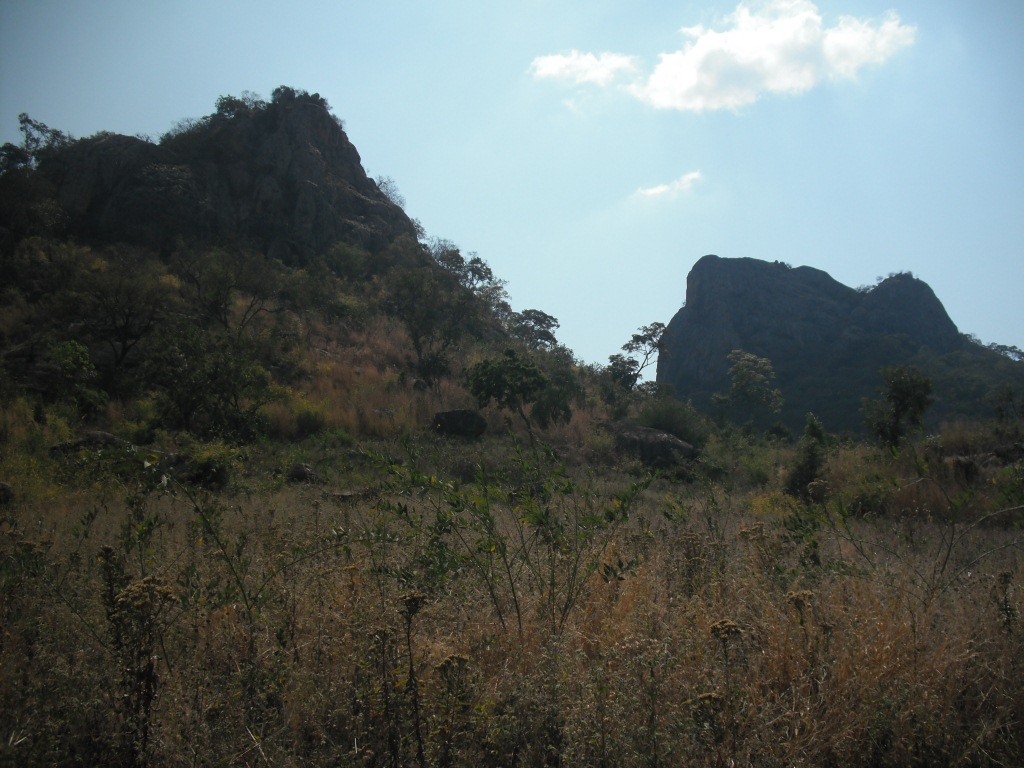
The landscape was mountainous and rocky. It was dry season
so there was dry grass and trees.
Eventually we reached the base of the mountain and we
started to hike up. When we reached the top we could see the areas surrounding the village.
The head of the house started to
cut the trees with his sharp axe. His wife was gathering up the pieces and
tying them up into a bundle to be carried. It wasn’t long until they had enough
wood and were ready to set off.
When we arrived the sun was setting, we took a bath, had our
supper and went to bed. You could hear children sing and dance around a wooden
fire as stories and jokes where told. It’s part of their life, village life,
community, happiness, peace, love, and simplicity.


 There a number of huts in the area, but
most importantly includes Mbona's hut and close to that his wife's hut Salima. After the death of Mbona she still played an
important role, she would be visited at night by Mbona in the form of an
enormous python and he would tell her the future, so as to inform the village
of what to plant and what not to. She would communicate to the village via a
trance like state, she was the oracle.
There a number of huts in the area, but
most importantly includes Mbona's hut and close to that his wife's hut Salima. After the death of Mbona she still played an
important role, she would be visited at night by Mbona in the form of an
enormous python and he would tell her the future, so as to inform the village
of what to plant and what not to. She would communicate to the village via a
trance like state, she was the oracle.
 The Khulubvi and Associated Mbona Sacred Rain
Shrines are a world heritage site (UNESCO).
The Khulubvi and Associated Mbona Sacred Rain
Shrines are a world heritage site (UNESCO).