

One of the world’s best hidden treasures lies in the warm heart
of Africa. They are the materialization of the words paradise, beauty and tranquility. These are the islands of Lake Malawi. These priceless treasures are handcrafted by the sheer force of Mother
Nature. One of the world’s well known geological wonders gave birth to these emerald islands, the African Rift Valley.
The East African rift valley that tears down to the very heart of Africa created a void, an abyss within this landlocked country. This crater is is no longer barren and desolate but it is Lake Malawi, the Lake of Stars, which cradles these spectacular emerald wonders. There
are a few well known islands and dozens of smaller islands scattered across the crystal clear turquoise waters. Some of the islands are so remote that few people have ever had the chance to glance at the untouched beauty.
These type of fresh water islands are found nowhere else and
are home to fish species found only in Malawi, thus the Lake Malawi National Parks was founded.
 |
| Photo From http://www.boomsbeat.com/articles/1627/20140325/the-third-largest-and-second-deepest-lake-in-africa-lake-malawi-photos.htm |

Lake Malawi National Park is located at the southern end of Lake Malawi. The park includes Cape Maclear peninsula, three other disjunct mainland areas, 12 islands and lake waters that lie within 100 m of the park's terrestrial components. The park covers an area of 94.1 km2 of which 7km2 is aquatic zone. The environment varies from rocky shorelines to sandy beaches and from forests to swamps and lagoons. Apart from the Malawian Cichlids, there are also other animals such as hippo, baboon, monkey and elephant which can be seen on the mainland. There are over 12 islands, below are just a few.
In Northen Mangochi, around the Monkey Bay area, you'll find a cluster of islands. To the east you find Thumbi and Mumbo island.
 |
| Thumbi West and behind it Mumbo island |
When the sun is setting on the golden sands of Cape Maclear, you will have a glimpse of the postcard scenery of the sun hiding away behind Thumbi island. There are actually two of these islands. There is Thumbi East and Thumbi West, they are either side of the Cape Pennisula. This is Thumbi West and it lies about a kilometer from the mainland. Behind Thumbi West is Mumbo island.
 |
| On Thumbi West Island |
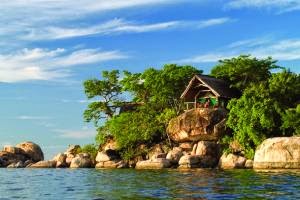
Mumbo Island
This island is simlply stunning. Virtually every picture taken of and on the island comes out perfect. Mumbo Island lies about 10km offshore from Cape Maclear. It is a beautiful deserted tropical paradise floating on crystal clear azure waters.
 |
| Photo From http://cawsmw.com/index.php/lodges/mumbo-island-camp/ |

Just North of the Cape Peninsula is Domwe island. This island may have not been an island at all. From its appearance it seems like it was the tip of the cape which broke away from the mainland but is ever so close. It is separated from the mainland by the narrow Ilala Gap. It is said that due to fluctuations in lake level over the millennia, the gap has been dry on several occasions, creating a passage to the mainland. As a result Domwe Island, unlike all other Lake Malawi islands, is well populated with mammals which have crossed onto the island during these dry times.

The region of Salima is home to a group of islands called the Maleri archipelago. This chain of islands is one of the most well known on the lake.

The Maleri islands are a group of three islands that are visible just off the coast of Salima. The islands can be clearly seen from the port town of Chipoka in Salima. The largest of the three islands is Maleri and it is about 168ha in size.
The second largest island is Nankhoma and it
is about 65ha in size. This island is home to the Blue Zebra Island Lodge.
 |
| Photo by Marumbo Thindwa |
 |
| Photo by Marumbo Thindwa |
Nakantenga island is the smallest, only about 18ha in size.
 |
| Photo by Adrianus Franciscus Johannes Marinus Maria Konings |
Besides these fairly small islands, there are much bigger giants floating on these pristine waters. The large islands are Likoma and Chizumulu. These islands are found in the Northern region of Lake Malawi, far east of Chintheche in Nkhatabay, closest to the Mozambique shore.


Likoma is the larger of two populated islands in Lake Malawi. Together with Chizumulu island, it forms the district of Likoma. This island flaunts the historic Anglican cathedral of St. Peter, an airstrip, port and as well as the beautiful island resorts.
 Chizumulu island is the smaller of the inhabited islands that make up the district of Likoma. The island has two large hills that seem to watch over it. From these hills you have some of the most amazing views of the landscape.
In the waters of central Mangochi you have Bird Island. This Bird sanctuary can be seen from many of the coastal resorts.

Bird Island is actually far from emerald. From the mainland the island is virtually a blinding chalk white. The island is home to the biggest breeding colony of white breasted comorants in the southern African region.
There are other smaller, more remote islands spread across the lake.
Mbenji
 |
| Photo by Adrianus Franciscus Johannes Marinus Maria Konings |
Kande

Chinyakhwazi & Chinyamwezi
 |
| Photo by Adrianus Franciscus Johannes Marinus Maria Konings |
These two islands, thought barren as they seem, are probably two of the most important in the region. The islands are used as key points in the Malawi Yatch marathon (First leg) and beneath the shimmering waters, are home to a unique species of Cichlid.
These are just a few of the spectacular scattered emerald islands. With breathtaking views, crystal waters and untamed beauty, who could resist. I believe you would not be disappointed travelling to any of them.


